MA Sequential Design /Illustration Website

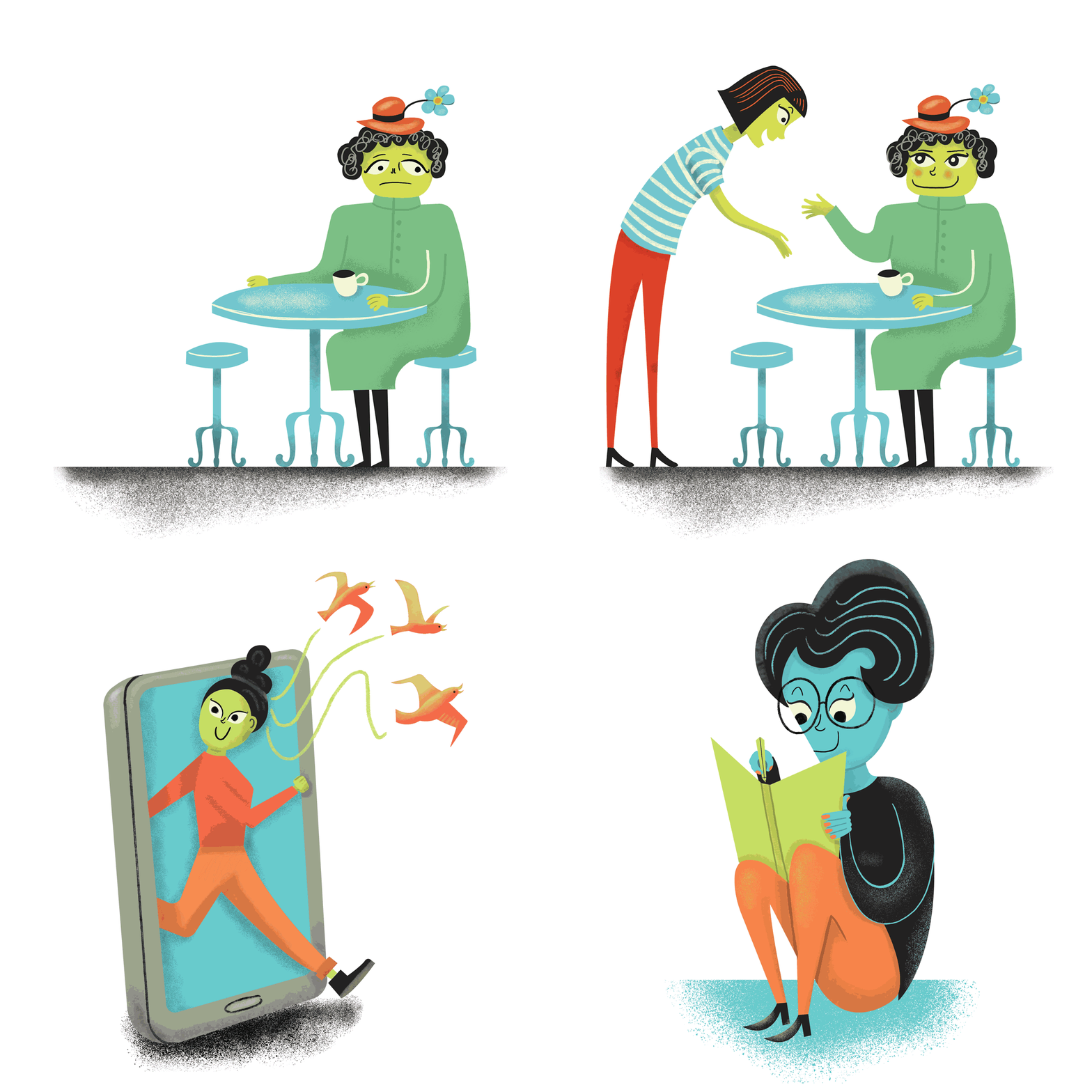
I’ve just finished building a website for the graduating year of the MA course which I’m currently on (I still have another long hard year to go!). I’ve found the whole process really interesting in terms of organising a group of artists to send me the content I need to get the site up and running, and also working with a group of students who all had very different ideas about what they wanted from the site. I’ve built a lot of websites during my career but getting all of the artists to send the correct information for the site was incredibly time consuming and frustrating at times.

I was careful to set down rules for the process at the start of the project. One of the things which I found really helped was only dealing with one person, who acted as a point of communication for all of the students on the course.

Now the site is pretty much finished apart for a few tweaks and more content to go in. I used the WordPress content management system to build it so that a couple of volunteer students can upload more content on behalf of the other students. It’s a really simple design and it functions well for the purpose:

ma2010.co.uk

Visit ma2010.co.uk

If you are interesting in attending the degree show these are the details:

University of Brighton Gallery, Grand Parade, Brighton BN2 0JY.
Friday 10th September – Friday 17th September
Gallery Hours: Monday – Saturday 10 a.m. to 5 p.m. Closed Sundays.

Drawing Out Ideas

Drawing Out Ideas

Many years ago, when I first arrived on my graphic design course at university I was really surprised to discover how many of the students didn’t draw and didn’t seem interested in drawing at all.  I think that it seemed so strange to me because they had enrolled on a course where ideas and creativity were so paramount, I couldn’t understand how anyone could be creative or have ideas without using drawing.

I still don’t.

No matter who you are or what you do, most of us want to generate ideas and be creative-that’s what makes us feel fulfilled as human beings.  Drawing for me and many others is a fundamental part of this idea-generation process.

So why is it so useful?

Well I wouldn’t say that I’m the best draughtsperson in the world but for me drawing is about communication.

A recent example of how I’ve used drawing in my everyday life is the sketch below:

bedfront

My friend had asked me to help her dismantle her Ikea bed, which she had just sold.  We had a short amount of time to take it apart and find the instructions.  Unfortunately we couldn’t find the instructions.  So, as we were wasting valuable dismantling time,  I decided instead to draw out a couple of diagrams of the bed showing how it fitted together with the various different screws.  It’s a crude (not like that) sketch but it did the job, because it clearly communicated all of the information necessary to put the bed back together.

Drawing can be used for so many purposes including planning, clarifying, modelling and observing.  Even the most ancient of civilisations have used drawings to communicate and express their ideas, which is why I’m baffled as to why it is ignored by individuals and institutions as an important tool for creativity today.

Cave Painting

Aurochs on a cave painting in Lascaux, France.

Drawing for business

I’ve worked in many design agencies/departments during the course of my career and with many designers and I’ve hardly seen any of them even do a small sketch before progressing to designing something on their machines.  I think that this is due to time constrains and pressure placed on them by clients and bosses more than anything else.  But still it is worrying that even design departments don’t seem utilise drawing as a tool.

Drawing can be used in so many different areas of a business.  Ideas are constantly needed for a business to be successful and that’s exactly what drawing can help you to do- generate original ideas.

How does it do this?

Well I think that the answer to is that it helps us to make connections.  We can’t hold many thoughts at the forefront of our minds for very long, so drawing allows us to sketch these thoughts out and make connections between them on paper.  If a picture is worth a thousand words and we are trying to make connections between different things to generate something new, then we have a much better chance of doing that through drawing.  It’s also playful and fun, and play is a proven idea generation technique.

Jason Santa-Maria has written an excellent article on why drawing and keeping sketchbooks are so important to help you to become a better thinker.  He has also set up a flickr group for sketchbook pages which are incredibly inspirational.

Drawing is useful for everything and anything. It isn’t just a tool for artists and designers.  It can be used to communicate and generate ideas, whatever you do in life.  Drawing is a tried and tested technique to help you to think differently. So pick up a pencil, and lend a hand in stopping the neglect of this ancient and invaluable method of expression and communication.

Some Old Work

I thought I’d write a post about some of my old work from University as I think some of it is pretty interesting.

So these are a few experimental websites which I created a few years ago.

Dream Odyssey

Dream Odyssey Site

The first is called Dream Odyssey. I combined illustration with simple animation in a Flash site to illustrate the story of Odysseus, based on the epic poem written by Homer. You can read about the project here and have a play with the interface here. I really like the animation I created for this project. It was all hand-drawn and then traced as vectors.

Interact With Me

Interact With Me Site

“Interact With Me” is an (annoying) interactive experimental web-art piece. It explores the relationships between the user and the interface; focussing on subverting the normal principles of good interaction design. Beware-this may make you go insane.

Sensory Substitution

Sensory Substitution Site

On a more serious subject, this is a project to explore the future of Sensory Substitution. Briefly explained (you can read more about it on the site), Sensory Substitution Devices can help a blind person to regain some sense of sight through touch or hearing or help a deaf person to regain some sense of hearing via vision or touch. I had to take the Wiki down as it was being spammed like crazy.

The Many Facets of Dementia

The Many Facets of Dementia

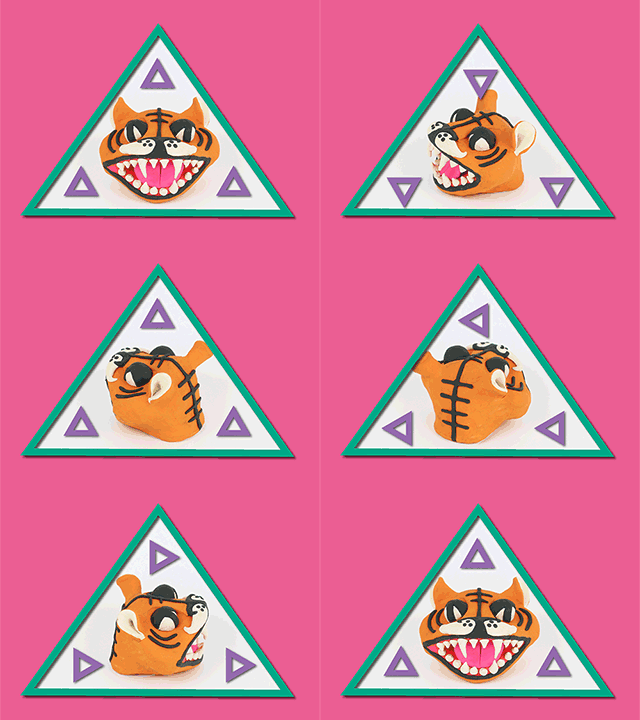
Finally, this photographic project was completed for the 2008 D&AD Student Awards. It explored the many facets of dementia. The extensive research undertaken for this project included: brain injuries, Agnosia, Surrealist objects and research into causes, symptoms and the history of dementia and Alzheimer’s disease. I got to make lots of models using various materials (and burning myself with a glue gun) for this project, which was great fun. I also got to do loads of research which I enjoyed.

Oooo New Website!

So I’ve finally finished the new site. You can see the links to my work sites on the right, along with my Flickr photostream and twitter feed – love those WordPress widgets.

I wanted to keep this site just as a simple blog site with no frills, just interesting content. It’s going to be packed full of useful information in the very near future. I’m going to get a few WordPress tutorial posts up soon and I’m hoping to write a post about the importance of sketchbooks for idea generation. So check back soon or subscribe to my blog.

In the meantime the Unstruck blog is regularly updated-some fantastic work on there from Alex, Anna, Adam and Maria, as well as all of the guest illustrators.

New Website Under Construction

My new site will be up soon.

You can look at the old site here – www.lucy-irving.com.

My illustration work here – www.irvingillustration.com.

Contact me here – lucy@lucyirving.com.

Or find me on twitter here – www.twitter.com/lucy_irving.

Check back soon to see my new site…